
Green energy refers to power generated from renewable sources that are naturally replenished, playing a key role in reducing carbon emissions and mitigating climate change. Among these, wind and solar energy are two of the most prominent technologies, both strongly influenced by wind. Wind turbines extract energy from the airflow and require careful aerodynamic design to maximize efficiency and withstand highly variable conditions. Similarly, solar systems—particularly photovoltaic (PV) trackers—must balance optimal solar exposure with structural resistance to wind loads.
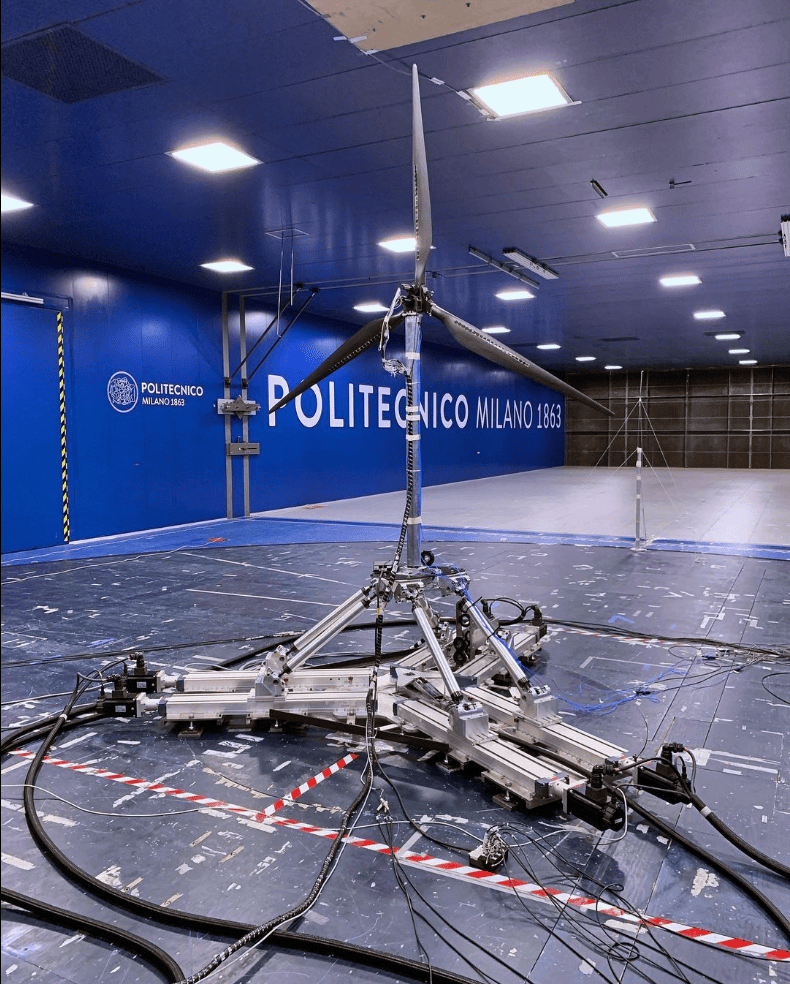
Over the past decades, wind energy has experienced steady growth and is now among the most cost-effective renewable technologies. Current challenges include maximizing performance at onshore sites and enabling efficient deployment in offshore environments. These goals have driven extensive experimental research, including wind tunnel testing of wind turbine models at the Politecnico di Milano GVPM. Such activities, integrated with numerical simulations and field measurements, are essential to improve the understanding of aerodynamic behavior at both turbine and wind farm scales.
The large boundary layer test section allows the use of models with rotor diameters between 1 and 2.5 m, enabling realistic representation of full-scale conditions. Advanced scaling methodologies ensure the engineering relevance of the results. A distinctive capability of the facility is the testing of floating wind turbines, supporting research on offshore systems for deep-water applications.
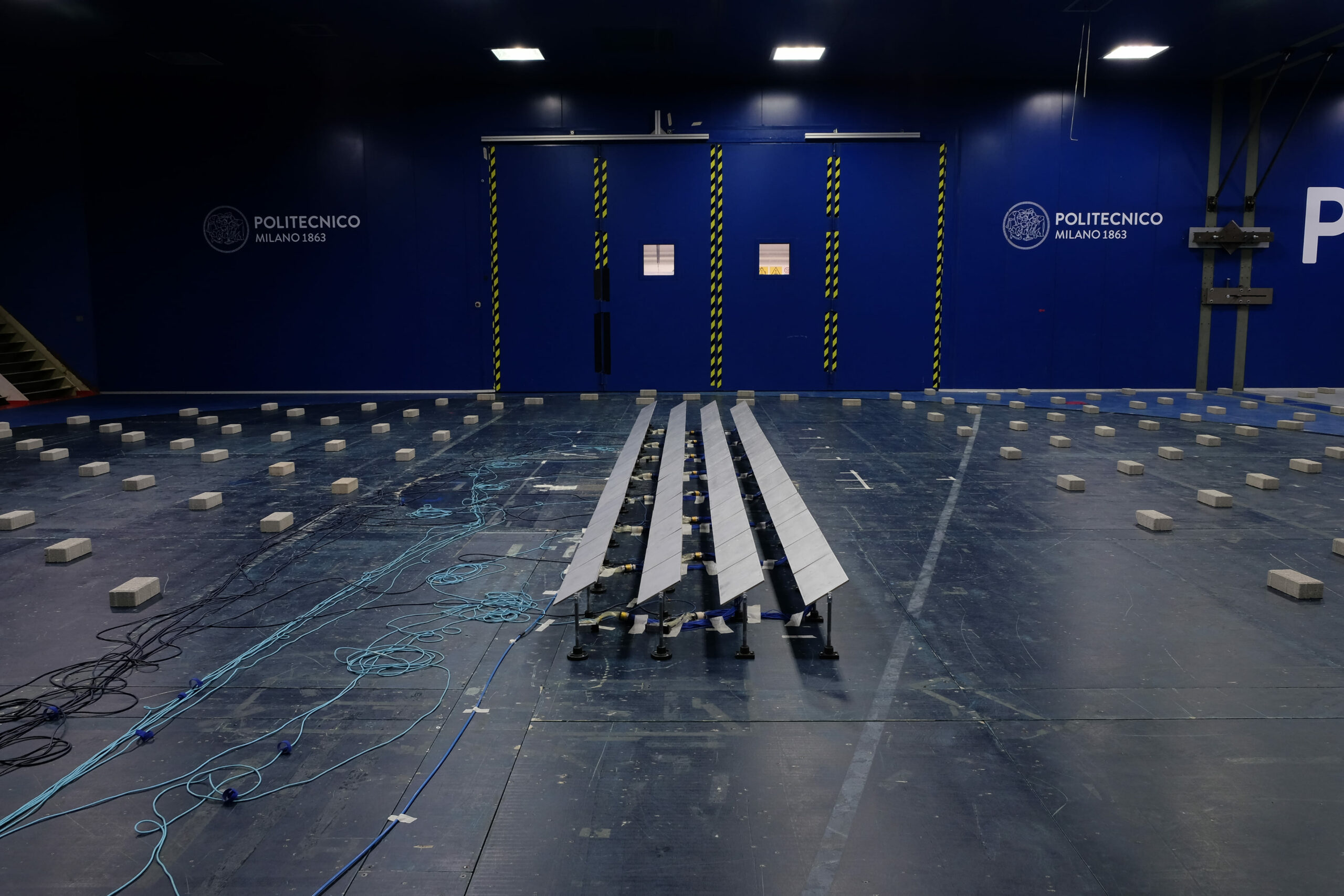
Wind tunnel testing also plays a crucial role in the development of PV trackers. These systems increase energy production by following the sun but are particularly sensitive to wind loading. Experiments at GVPM focus on both rigid models, to measure pressure distributions on the panels and resulting loads, and aeroelastic sectional models, to investigate fluid–structure interaction and identify critical instability conditions.