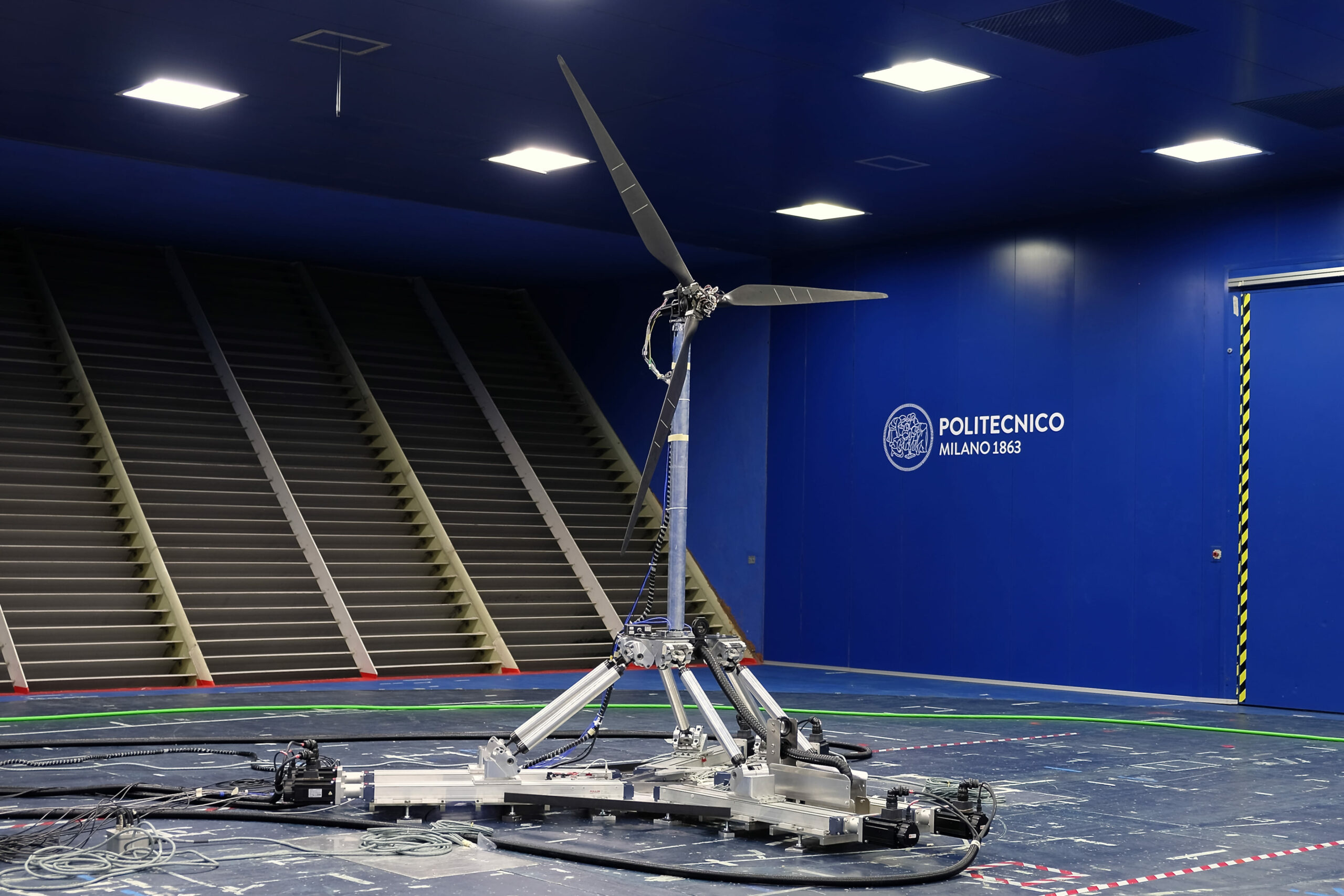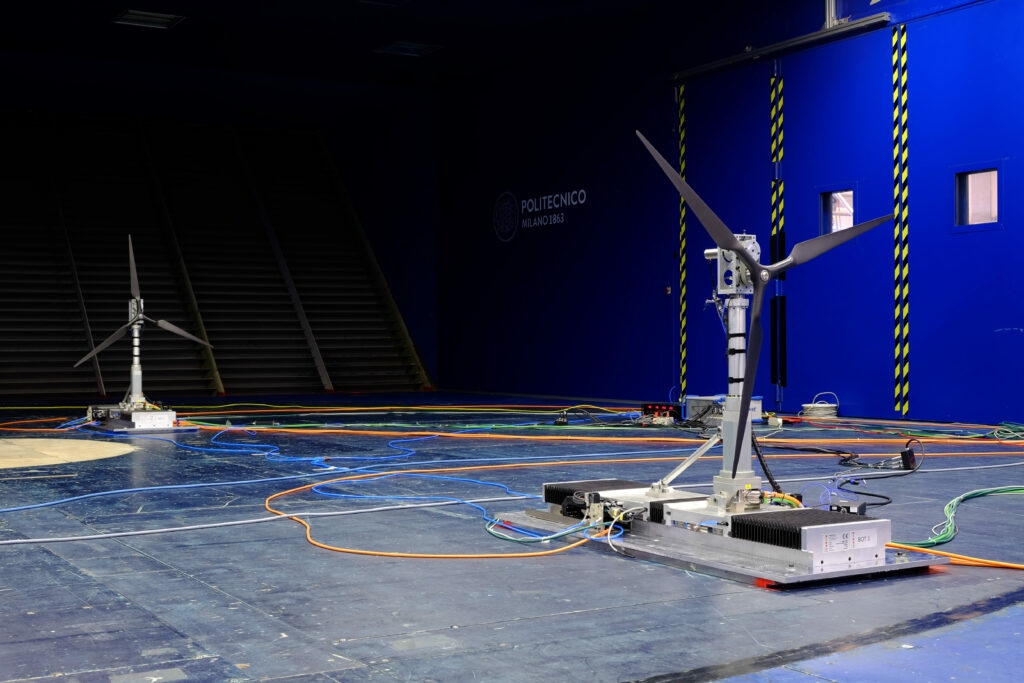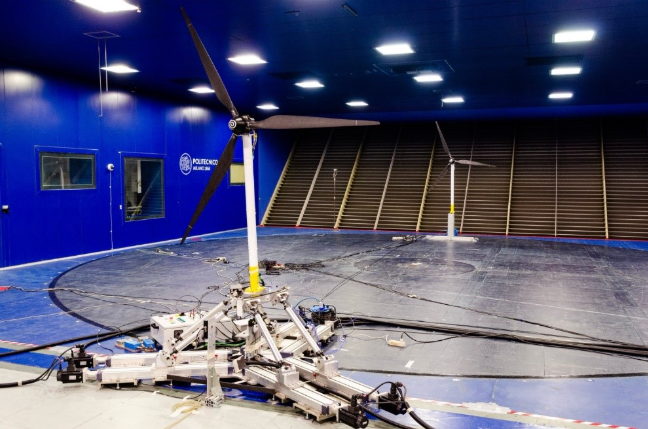

Wind tunnel testing has become a key component of wind energy research at Politecnico di Milano in recent years, supporting the development of advanced onshore and offshore wind technologies. Within the Department of Mechanical Engineering, the Department of Aerospace Science and Technology, and the Department of Energy, experimental activities are closely integrated with numerical modeling to address the complex, multidisciplinary nature of modern wind turbines, including aerodynamics, aeroelasticity, control, and hydrodynamics.
The Politecnico di Milano wind tunnel provides a highly controlled environment for investigating turbine performance and wind farm behavior across a wide range of operating conditions. Recent research has focused on floating offshore wind turbines, whose dynamics are strongly influenced by the combined action of wind and wave-induced motions, as well as on wind farms, where aerodynamic interactions driven by wake effects are significantly affected by atmospheric boundary layer conditions. To reproduce the motion of floating wind turbines, innovative experimental setups have been developed, including hardware-in-the-loop systems and six-degree-of-freedom robotic platforms capable of simulating realistic platform dynamics during testing. Wake effects—particularly in floating configurations—play a major role in energy production and structural loading, and are therefore extensively investigated through scaled wind tunnel models.
Experimental campaigns carried out in recent years enable detailed measurements of aerodynamic loads, wake development, and turbine–turbine interactions, which are critical for understanding wind farm performance. The data collected in the wind tunnel are used to validate and improve both high-fidelity and engineering-level simulation tools, contributing to the design of more efficient and reliable wind turbines.